
Could a short, gentle treadmill session help you feel more positive and mentally sharper? A 2026 study published in Imaging Neuroscience offers an encouraging—though still early—answer.
Researchers found that just 10 minutes of very slow treadmill running improved mood and performance on a test of executive function in a small group of healthy young adults. Here’s what the study found, what it may mean for your daily routine, and where its limits lie.
What did the researchers test?
The randomized crossover study included 24 healthy young adults. On one visit, participants completed 10 minutes of very slow running on a treadmill at about 35% of their peak oxygen uptake. Their individual speeds ranged from approximately 3 to 6 km/h (about 1.9 to 3.7 mph). On another visit, they rested while seated for the same length of time.
Before and after each session, researchers assessed participants’ mood and used the Stroop test to measure executive function—the mental skills involved in attention, self-control, and switching between tasks. Functional near-infrared spectroscopy (fNIRS) was used to observe changes in prefrontal cortex activity.
What did the study find?
Compared with seated rest, the 10-minute slow-running session was associated with:
- A more pleasant and energized mood
- Faster performance on the Stroop task, suggesting a short-term improvement in executive function
- Greater activity in parts of the left prefrontal cortex, a brain region involved in mood regulation and cognitive control
The researchers also observed that the gentle vertical rhythm of running was related to the change in pleasant mood. This is an interesting clue, but it does not yet prove that the movement pattern itself caused the benefit.
Why this matters for busy days
The most practical takeaway is not that every workout needs to be intense. It is that a brief, manageable movement break may be worthwhile—even when you have only 10 minutes.
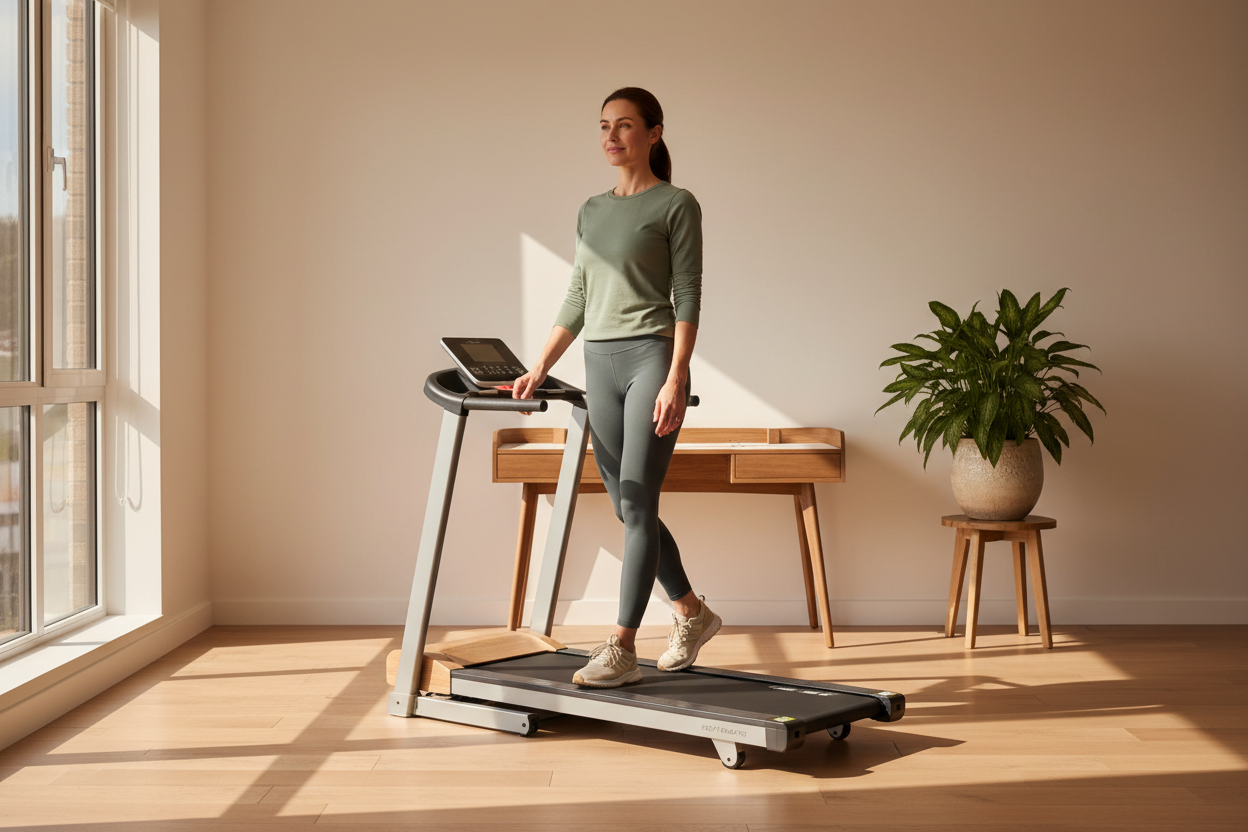
A compact home treadmill can reduce the friction between deciding to move and actually doing it. There is no commute to a gym, no complicated setup, and no need to turn a movement break into a full training session. The goal is consistency: choose a comfortable pace that leaves you in control and able to breathe easily.
A simple 10-minute treadmill reset
- Minutes 0–2: Begin with an easy walk and settle into a natural stride.
- Minutes 2–8: Gradually increase to a comfortable brisk walk—or a very light jog only if your treadmill is designed for running.
- Minutes 8–10: Slow down and finish with relaxed breathing.
Use the safety key if your treadmill has one, keep the surrounding area clear, wear suitable footwear, and stop if you feel pain, dizziness, or unusual shortness of breath.
Walking pad or running treadmill?
The study tested very slow running, not ordinary desk walking. A walking pad may still be a convenient way to add low-intensity movement to your day, but the study does not show that walking produces the same brain effects. Never jog on a device unless its manufacturer explicitly rates it for running and its speed, deck size, and safety features are appropriate.
What the study does—and does not—prove
These findings are promising, but they should be kept in perspective. The study involved only 24 healthy young adults and measured the immediate effects of a single 10-minute session. It does not establish long-term benefits, prove the same result for every age or health group, or show that treadmill exercise treats a medical condition.
Still, it adds to a useful idea: a small dose of comfortable movement can be a realistic part of a better workday.
Make movement easier to fit into your routine
If you want a compact option for walking while working or taking short movement breaks, explore the BFH Under-Table Treadmill. Choose a pace that matches your device, space, fitness level, and health needs.
This article is for general educational purposes and is not medical advice. If you have a health condition, are pregnant, are recovering from injury, or are new to exercise, consult a qualified healthcare professional before changing your activity routine.
Study source
Damrongthai C, Kuwamizu R, Ochi G, et al. “Slow running benefits: Boosts in mood and facilitation of prefrontal cortex function even at very light intensity.” Imaging Neuroscience (2026). https://doi.org/10.1162/IMAG.a.1297. See also the PubMed record and the University of Tsukuba research summary.
Share:
Can Red Light Help Wrinkles?
Posture Awareness at Your Desk: A 5-Minute Reset Routine